
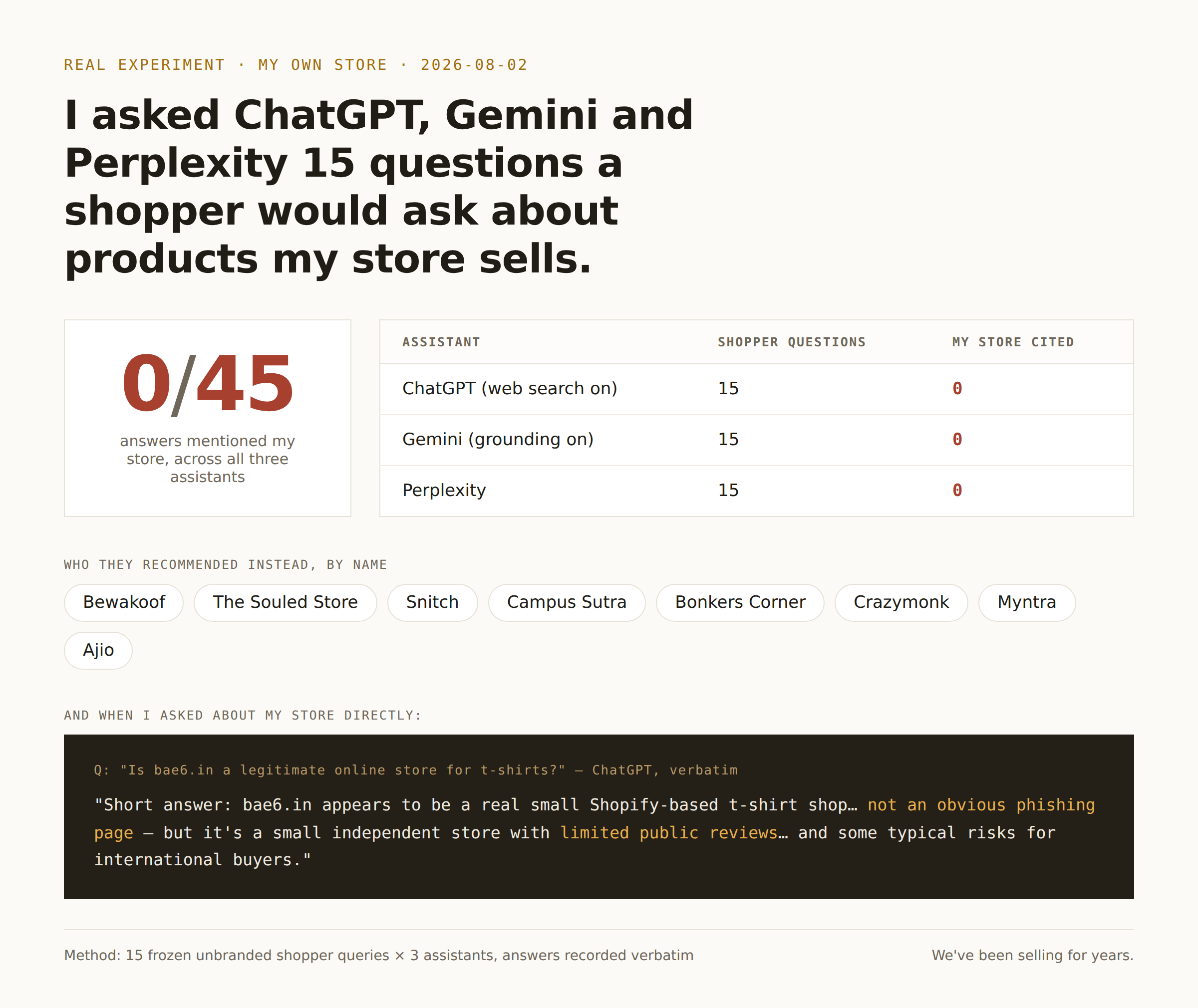
We asked ChatGPT, Gemini and Perplexity about products our own store sells. 0 mentions in 45 answers.
We build Pollen, a product whose whole job is making online stores readable, citable and recommendable by AI assistants. We also run a small graphic t-shirt store in India called bae6.in, which doubles as our testbed: every Pollen feature runs on our own store first. On August 2nd we pointed Pollen’s answer probe at it: 15 questions a real shopper might ask an AI assistant about products in our category, asked to ChatGPT, Gemini and Perplexity with web search enabled, every answer recorded verbatim.
The unbranded result: our store appeared in zero of the 45 answers. We are publishing it anyway, because the point of measuring is knowing where you actually stand, and because the rest of the numbers tell a more interesting story.
The method, so you can run it yourself
Nothing here requires special tooling. The design matters more than the tools:
- 15 unbranded shopper questions, written from the catalog, not the brand. Things like “best oversized graphic t-shirts for men under 1000 rupees India” and “where can I buy unique graphic tees online in India”. Unbranded is the point: it measures whether assistants find you when the shopper does not already know you.
- 5 branded questions as a control, including the uncomfortable one: “Is bae6.in a legitimate online store for t-shirts?”
- Three assistants (ChatGPT, Gemini, Perplexity), each with web search or grounding enabled, so the answers reflect live retrieval rather than training data.
- Verbatim recording. Not “did we rank”, but the full answer text, so you can see who was recommended and with what reasoning.
- Frozen questions. The same 15 get re-asked on a schedule, which is the only way a before/after means anything. Assistant answers are stochastic; one-off tests mislead in both directions.
What the answers actually said
The unbranded result was uniform: 0/15 on ChatGPT, 0/15 on Gemini, 0/15 on Perplexity. The answers were not empty; they were full of recommendations for other stores. Bewakoof, The Souled Store, Snitch, Campus Sutra, Bonkers Corner and Crazymonk were recommended by name, repeatedly, along with the marketplaces Myntra and Ajio.
The branded control told the other half of the story. Asked directly whether our store is legitimate, ChatGPT answered, verbatim:
“Short answer: bae6.in appears to be a real small Shopify-based t-shirt shop… not an obvious phishing page – but it’s a small independent store with limited public reviews… and some typical risks for international buyers.”
“Not an obvious phishing page” is what an AI assistant says about a store it can read but cannot socially verify. The assistants were not wrong to hedge; independent, citable evidence about the store barely exists yet. Trust, to an AI assistant, is a citation problem.
Where the work shows, and where it does not yet
We have been working on this store’s agent readiness with Pollen for months: multimodal enrichment of every product into structured facts, Schema.org Product JSON-LD on every product page, an AI-crawler allowlist, llms.txt, a store MCP endpoint, and managed catalog feeds into Google Merchant Center and Meta (2,713 offers live on each). The probe is how we check what all of that buys, honestly. The current scorecard:
- Assistants can find and read the store when asked about it: 14 of 15 branded answers cited bae6.in, with product-level detail in most of them. That is the machinery working: crawlable, structured, verifiable product data being retrieved and used in live answers.
- AI crawler traffic responded within days of the crawl and structured-data fixes. We log AI user agents server-side, split into crawlers and the retrieval fetches assistants make while answering a live question. That split is worth having on any store: retrieval fetches are the signal that an assistant is actually using your pages.
- Unbranded recommendations are the unclosed gap: 0/45. Against category incumbents with years of reviews, press and marketplace presence, readable product data is necessary but not sufficient. Assistant indexes refresh slowly and trust accumulates from evidence other people publish about you. This is exactly why the questions are frozen: we will re-run the same 15 and publish the delta, whichever way it goes.
What we would tell any store owner to check first
1. Whether AI crawlers can reach you at all
Robots rules and security plugins block GPTBot, ClaudeBot, PerplexityBot and Google-Extended by default more often than most merchants realize. On our own journey we also found a page cache serving AI bots stale pages while hiding their visits from our logs, and a Cloudflare zone toggle returning 403 to AI crawlers at the edge, where no on-site fix could help. If the bots cannot read you, you do not exist to the assistant. (Both findings are notes of their own, coming here soon.)
2. Whether your product pages carry structured data
Assistants lean hard on Product JSON-LD when they compare items: price, availability, brand, ratings. A product page that ships without structured data is a strictly worse citation than a competitor page that has it. Most of the stores recommended in our 45 answers have complete Product markup.
3. Whether anything crawlable proves your store is real
“Limited public reviews” is the assistant telling you what it looked for and did not find: crawlable reviews, an about page with a real address, consistent brand mentions on independent sites. No tool fixes this overnight, ours included; it is the slow accumulation of citable proof. Knowing that is the gap is what lets you work on it deliberately.
Disclosure
This note is us dogfooding our own product. Pollen runs this exact probe against your store and catalog, shows you every AI answer verbatim, scores each product on what agents can read, and automates the fixable parts; the free scan takes a minute. But the manual version of this experiment costs nothing except an hour of honesty, and we are happy to share the full question set and detection method if you want to run it yourself. Every number in this note comes from the August 2nd run on our own store; total API cost for the 60 answers was $1.29.